Giữ nhịp Sống Xanh,
hơi thở vững vàng
Lý do của bạn là gì

đặc biệt người có bệnh nền hoặc suy giảm miễn dịch có nguy cơ cao hơn mắc các bệnh hô hấp và gặp các biến chứng nặng như Viêm phổi, Nhập viện, thậm chí cần điều trị ICU 1,2,3,4


Ai cũng có một lý do
để giữ nhịp SỐNG XANH
Dù là vì gia đình, vì bạn bè hay những khoảnh khắc quý giá không thể lấy lại của chính mình, tất cả đều cần một hệ hô hấp khoẻ mạnh.
Để được chứng kiến sự trưởng thành của con cháu
Mỗi bước đi đầu đời, mỗi tiếng cười đầu tiên đều đáng để bạn ở đó, khoẻ mạnh và trọn vẹn.

Để được quây quần bên gia đình hay những người thân yêu
Hạnh phúc đến từ điều giản đơn như mâm cơm nhà qua bao năm chưa từng thiếu một ai.

Để được giữ thế giới trong lành cho hơi thở của con cháu
Sức khoẻ hô hấp của ông bà là khởi đầu cho sự an toàn và là nguồn cội hạnh phúc của gia đình.

Để được tận hưởng khoảnh khắc sống khoẻ bên đồng niên
Dù tóc đã bạc, cuộc hẹn tri kỷ vẫn vẹn nguyên tiếng cười và những sự hiện diện thân thương.

Để được tự do nuông chiều ước mơ hồi trẻ của riêng mình
Qua nửa cuộc đời lo toan, giờ là lúc bạn sống cho mình, tự do đi xa và làm điều ngày trẻ đã bỏ lỡ.

ĐỪNG ĐỂ BỆNH HÔ HẤP TRỞ THÀNH NGUY CƠ với người lớn tuổi 1,2,3,4
Người từ 60 tuổi trở lên, đặc biệt có bệnh nền hay suy giảm miễn dịch, nguy cơ mắc các bệnh hô hấp như Cúm, Phế cầu khuẩn và RSV (RSV A & B) cao hơn, và gặp các biến chứng nặng như
 Viêm phổi
 Nhập viện
 Nhập ICU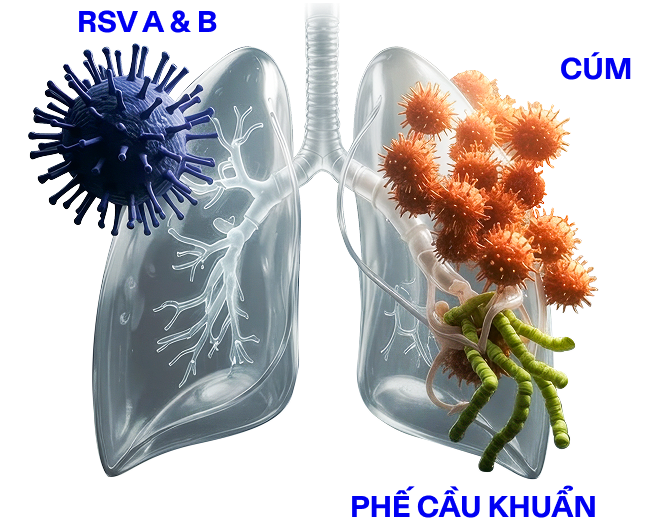

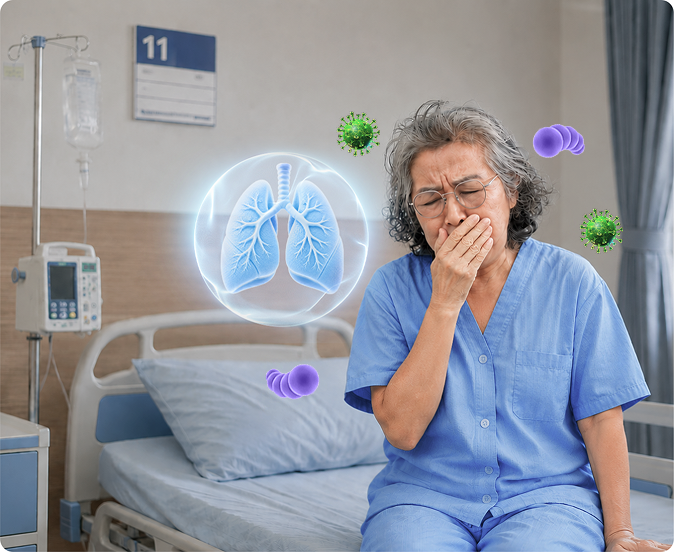
Nguy cơ mắc viêm phổi, nhập viện do Phế cầu, RSV tăng cao hơn vì lão hoá miễn dịch3

18,7–68,8 ca/100.000
người-năm tại Mỹ 30






Phòng ngừa đúng cách là
một phần quan trọng
Giúp người lớn tuổi giảm nguy cơ mắc các bệnh hô hấp phổ biến. Trao đổi với bác sĩ để được tư vấn cách phòng ngừa bệnh hô hấp phù hợp. 11

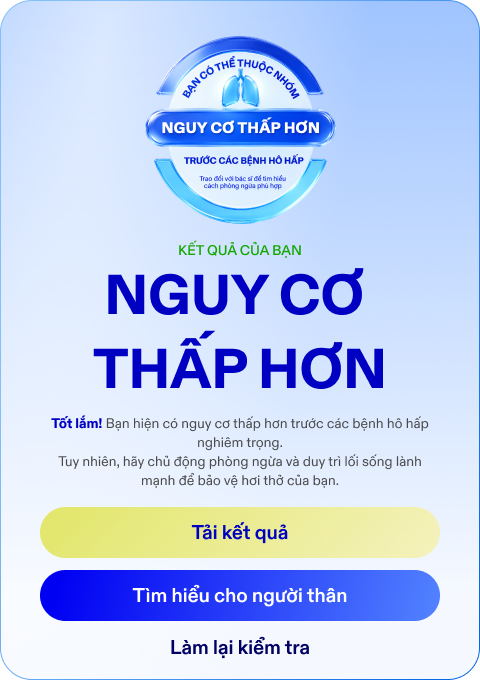
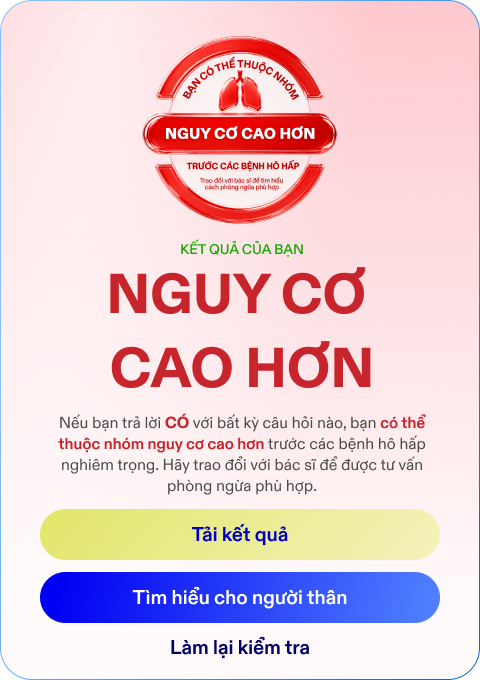
TỰ ĐÁNH GIÁ NGUY CƠ CỦA BẠN
BẠN CÓ
CÁC YẾU TỐ NGUY CƠ
LÀM TĂNG KHẢ NĂNG MẮC
BỆNH HÔ HẤP NGHIÊM TRỌNG?

* Vui lòng trao đổi với bác sĩ để được tư vấn phù hợp.
Cúm
Influenza
Là vi rút hô hấp lây lan nhanh, có thể gây biến chứng nặng như viêm phổi, nhiễm trùng huyết.18
Có 4 típ vi rút cúm (A, B, C, D); trong đó cúm A (A/H1N1pdm09 và A/H3N2) thuộc nhóm vi rút cúm đã từng gây ra các đại dịch trong lịch sử và cúm B (B/Victoria và B/Yamagata) gây dịch cúm mùa ở người. Cúm C thường gây bệnh nhẹ, còn cúm D chủ yếu ở gia súc và chưa ghi nhận gây bệnh ở người.18
Mỗi năm trên toàn cầu ghi nhận18
Mùa cúm 2024- 2025 tại Mỹ, người lớn ≥65 tuổi chiếm
57% ca nhập viện và 71% ca tử vong do cúm 28
95,4% người lớn ≥65 tuổi nhập viện vì cúm có ≥1 bệnh nền (Mạng lưới Giám sát Nhập viện do Cúm, Mỹ, 2010–2023) 29
Phế cầu khuẩn
Streptococcus pneumoniae
Hơn 100 típ huyết thanh.13
Là vi khuẩn gây viêm phổi, nhiễm khuẩn huyết, viêm màng não, viêm tai giữa cấp và viêm xoang13. Các bệnh do phế cầu khuẩn vẫn là gánh nặng sức khỏe cộng đồng trên toàn cầu.26
Mỗi năm tại Mỹ ước tính14
Người lớn ≥65 tuổi có bệnh nền mạn tính so với người khỏe mạnh 5

RSV
Respiratory Syncytial Virus
Có 2 phân nhóm: RSV A & RSV B, có khả năng gây bệnh nặng như nhau.15
Là vi rút thường gây các triệu chứng nhẹ giống cảm lạnh và phần lớn tự khỏi trong 1–2 tuần16,27. Tuy nhiên, ở người lớn tuổi và người có bệnh nền mạn tính, RSV có thể tiến triển thành viêm phổi hoặc làm trầm trọng thêm các bệnh lý sẵn có như hen, bệnh phổi tắc nghẽn mạn tính (COPD) và suy tim27. Những biến chứng này có thể dẫn đến nhập viện, điều trị tại khoa hồi sức tích cực (ICU) hoặc tử vong8.
Mỗi năm, người lớn ≥65 tuổi tại Mỹ17
Người từ 60 tuổi trở lên nhập viện vì RSV sẽ25
Trang bị kiến thức
cho
hành trình sức khoẻ
Tải về các tài liệu để chủ động bảo vệ sức khỏe hô hấp của bạn và gia đình.

Checklist kiểm tra &
phòng ngừa bệnh hô hấp
Nhận diện yếu tố nguy cơ và các bước chăm sóc chủ động.

Câu hỏi dành cho bác sĩ
Danh sách câu hỏi giúp bạn trao đổi hiệu quả với bác sĩ về phòng ngừa các bệnh hô hấp phổ biến.
Bạn cần biết gì về sức khoẻ hô hấp?
Khi được tiếp cận thông tin chính xác, bạn có thể nhận biết rõ các nguy cơ và chủ động bảo vệ sức khỏe của mình và gia đình.
Từ 60 tuổi, nguy cơ mắc bệnh hô hấp nghiêm trọng tăng rõ rệt do hệ miễn dịch suy giảm tự nhiên theo tuổi (lão hoá miễn dịch).2
Người ≥65 tuổi có nguy cơ viêm phổi do phế cầu khuẩn cao gấp khoảng 7 lần người 18–49 tuổi.5
Có, với cả Phế cầu khuẩn lẫn RSV.
Người mắc bệnh phổi tắc nghẽn mạn tính (COPD) có nguy cơ nhập viện vì RSV cao gấp 9,7 lần và nguy cơ viêm phổi do phế cầu cao gấp khoảng 4 lần. Người suy tim có nguy cơ nhập viện vì RSV cao gấp 8 lần. 7, 8, 10
Các triệu chứng thường gặp gồm: ho, sốt, đau tức ngực, khó thở, thở khò khè, mệt mỏi nặng — cần được thăm khám sớm.
Ở người lớn tuổi, các triệu chứng có thể nhẹ hơn hoặc không điển hình (ví dụ lú lẫn, giảm tỉnh táo).
Liên hệ bác sĩ ngay khi khó thở, đau tức ngực, chóng mặt hoặc lú lẫn đột ngột, hoặc triệu chứng nặng lên.
Có thể — và tình trạng nhiễm cùng lúc này làm bệnh nặng hơn ở người cao tuổi.
Nhiễm RSV có thể làm suy yếu hàng rào bảo vệ đường hô hấp và làm tăng nguy cơ nhiễm thêm vi khuẩn, trong đó có phế cầu (Streptococcus pneumoniae) gây viêm phổi. Nhiễm cùng lúc vi rút và vi khuẩn có thể làm bệnh nặng hơn, thời gian nằm viện dài hơn, tỷ lệ vào phòng chăm sóc đặc biệt (ICU) cao hơn và tăng nguy cơ tử vong ở người cao tuổi.
Nếu người lớn tuổi có triệu chứng hô hấp nặng lên, hãy đưa đến cơ sở y tế và thảo luận với bác sĩ.
Duy trì lối sống lành mạnh, tránh tiếp xúc với người đang bệnh, rửa tay thường xuyên, và đặc biệt trao đổi với bác sĩ về các biện pháp phòng ngừa phù hợp với tình trạng sức khỏe cá nhân của bạn.3

Kiểm tra nguy cơ ngay hôm nay. Một bước nhỏ cho sức khỏe hô hấp của bạn.
Tài liệu tham khảo
- Weyand CM, Goronzy JJ. Aging of the immune system. Mechanisms and therapeutic targets. Ann Am Thorac Soc. 2016 Dec;13(Suppl 5):S422-S428. doi:10.1513/AnnalsATS.201602-095AW. PMID: 28005419. PMCID: PMC5291468.
- CDC. People at increased risk for severe respiratory illnesses. Updated Aug 2025. Available from: https://www.cdc.gov/respiratory-viruses/risk-factors/index.html. Accessed: 27 Jul 2026.
- CDC. About respiratory illnesses. Atlanta (GA): CDC. Available from: https://www.cdc.gov/respiratory-viruses/about/index.html. Accessed: 27 Jul 2026.
- Zhao L, Wu L, Xu W, et al. Diagnostic techniques for critical respiratory infections: update on current methods. Heliyon. 2023;9(8):e18957. doi:10.1016/j.heliyon.2023.e18957. PMID: 37600408. PMCID: PMC10432708.
- Grant LR, Meche A, McGrath L, Miles A, Alfred T, Yan Q, et al. Risk of Pneumococcal Disease in US Adults by Age and Risk Profile. Open Forum Infect Dis. 2023;10(5):ofad192. doi:10.1093/ofid/ofad192.
- Grijalva CG, Wrenn JO, Schmitz JE, et al. Incidence rates of RSV-associated hospitalizations among adults in Middle Tennessee, United States, October 2022 through September 2023. Influenza Other Respir Viruses. 2025;19(8):e70150. doi:10.1111/irv.70150. PMID: 41247261. PMCID: PMC12378065.
- Vila-Corcoles A, Aguirre-Chavarria C, Ochoa-Gondar O, et al. Influence of chronic illnesses and underlying risk conditions on the incidence of pneumococcal pneumonia in older adults. Infection. 2015;43(6):699-706. doi:10.1007/s15010-015-0801-y. PMID: 26037386.
- Penders Y, Brusselle G, Falsey AR, et al. Burden of respiratory syncytial virus disease in adults with asthma and chronic obstructive pulmonary disease: a systematic literature review. Curr Allergy Asthma Rep. 2025;25(1):14. doi:10.1007/s11882-025-01194-w. PMID: 39994162. PMCID: PMC11850418.
- Cilloniz C, Torres A. Diabetes mellitus and pneumococcal pneumonia. Diagnostics (Basel). 2024;14(8):859. doi:10.3390/diagnostics14080859. PMID: 38667504.
- Kujawski SA, Whitaker M, Ritchey MD, et al. Rates of respiratory syncytial virus (RSV)-associated hospitalization among adults with congestive heart failure — United States, 2015–2017. PLoS One. 2022;17(3):e0264890. doi:10.1371/journal.pone.0264890.
- CDC. Preventing respiratory illnesses. Updated 18 Aug 2025. Available from: https://www.cdc.gov/respiratory-viruses/prevention/index.html. Accessed: 27 Jul 2026.
- CDC. Risk factors for pneumonia. Updated 25 Feb 2026. Available from: https://www.cdc.gov/pneumonia/risk-factors/index.html. Accessed: 27 Jul 2026.
- CDC. Clinical overview of pneumococcal disease. Updated 25 Feb 2026. Available from: https://www.cdc.gov/pneumococcal/hcp/clinical-overview/index.html. Accessed: 27 Jul 2026.
- CDC. Chapter 11: pneumococcal. Manual for the surveillance of vaccine-preventable diseases. Updated 17 Jan 2025. Available from: https://www.cdc.gov/surv-manual/php/table-of-contents/chapter-11-pneumococcal.html. Accessed: 27 Jul 2026.
- Rzymski P, Poniedziałek B, Zarębska-Michaluk D, et al. High seroprevalence and high risk: why are older adults more prone to respiratory syncytial virus? J Virol. 2025;99(10):e01432-25. doi:10.1128/jvi.01432-25.
- CDC. RSV in adults. Updated 20 Feb 2026. Available from: https://www.cdc.gov/rsv/adults/index.html. Accessed: 27 Jul 2026.
- World Health Organization. Respiratory syncytial virus (RSV). Updated Dec 2025. Available from: https://www.who.int/news-room/fact-sheets/detail/respiratory-syncytial-virus-(rsv). Accessed: 27 Jul 2026.
- World Health Organization. Influenza (seasonal). Updated 28 Feb 2025. Available from: https://www.who.int/news-room/fact-sheets/detail/influenza-(seasonal). Accessed: 27 Jul 2026.
- Deng Y, Herbert JA, Robinson E, et al. Neutrophil-airway epithelial interactions result in increased epithelial damage and viral clearance during respiratory syncytial virus infection. J Virol. 2020;94(13):e02161-19. doi:10.1128/JVI.02161-19.
- Mitsi E, Nikolaou E, Goncalves A, et al. RSV and rhinovirus increase pneumococcal carriage acquisition and density, whereas nasal inflammation is associated with bacterial shedding. Cell Host Microbe. 2024;32(9):1608-20. doi:10.1016/j.chom.2024.07.024.
- Jeannoël M, Lina G, Rasigade JP, et al. Microorganisms associated with respiratory syncytial virus pneumonia in the adult population. Eur J Clin Microbiol Infect Dis. 2019;38(1):157-60. doi:10.1007/s10096-018-3407-3. PMID: 30353485.
- Godefroy R, Giraud-Gatineau A, Jimeno MT, et al. Respiratory syncytial virus infection: its propensity for bacterial coinfection and related mortality in elderly adults. Open Forum Infect Dis. 2020;7(12):ofaa546. doi:10.1093/ofid/ofaa546.
- CDC. Symptoms and care of RSV. Updated 20 Feb 2026. Available from: https://www.cdc.gov/rsv/symptoms/index.html. Accessed: 27 Jul 2026.
- CDC. Pneumococcal disease symptoms and complications. Updated 25 Feb 2026. Available from: https://www.cdc.gov/pneumococcal/signs-symptoms/index.html. Accessed: 27 Jul 2026.
- Tseng HF, Sy LS, Ackerson B, et al. Severe morbidity and short- and mid- to long-term mortality in older adults hospitalized with respiratory syncytial virus infection. J Infect Dis. 2020;222(8):1298-310. doi:10.1093/infdis/jiaa361. PMID: 32591787.
- WHO. Pneumococcal disease. Available from: https://www.who.int/teams/health-product-policy-and-standards/standards-and-specifications/norms-and-standards/vaccine-standardization/pneumococcal-disease. Accessed: 05 Aug 2026.
- CDC. Clinical overview of RSV.18 Aug 2025. Available from: https://www.cdc.gov/rsv/hcp/clinical-overview/index.html. Accessed: 05 Aug 2026.
- CDC. 2024–2025 influenza season summary: severity, disease burden, and burden prevented. 12 March 2026. Available from: https://www.cdc.gov/flu-burden/php/data-vis-vac/2024-2025-prevented.html. Accessed: 08 Oct 2026.
- Naquin A, O'Halloran A, Ujamaa D, et al. Laboratory-confirmed influenza-associated hospitalizations among children and adults — Influenza Hospitalization Surveillance Network, United States, 2010–2023. MMWR Surveill Summ. 2024;73(6):1-18. Available from: https://www.cdc.gov/mmwr/volumes/73/ss/ss7306a1.htm. Accessed: 08 Oct 2026.
- Cossrow, N., Bailey, M. D., Huang, Y. L., Ai, L., Mohanty, S., McGuinn, V. C., & Johnson, K. D. (2026). Incidence of pneumococcal disease and pneumococcal vaccine uptake among US adults by age and risk groups. Current Medical Research and Opinion, 42(2), 365–377. https://doi.org/10.1080/03007995.2026.2661502